A forward P&L your leadership team can explain.
Your projects can show healthy margins while the firm misses its profit target. Connect the work ahead, the people who deliver it and the costs the company carries, so the next financial conversation starts with what moves the result.
Project contribution is not the company result.
A delivery report can show the margin on client work. The company still pays for people between projects, internal work, leave and SG&A. A CFO needs to see those costs in the period they belong to, then explain what is changing.
Profitdrive is built for IT and professional-services firms, including teams of around 25–150 people. The accounting book stays where it is; the forward P&L starts from pipeline, projects, people cost and overhead.
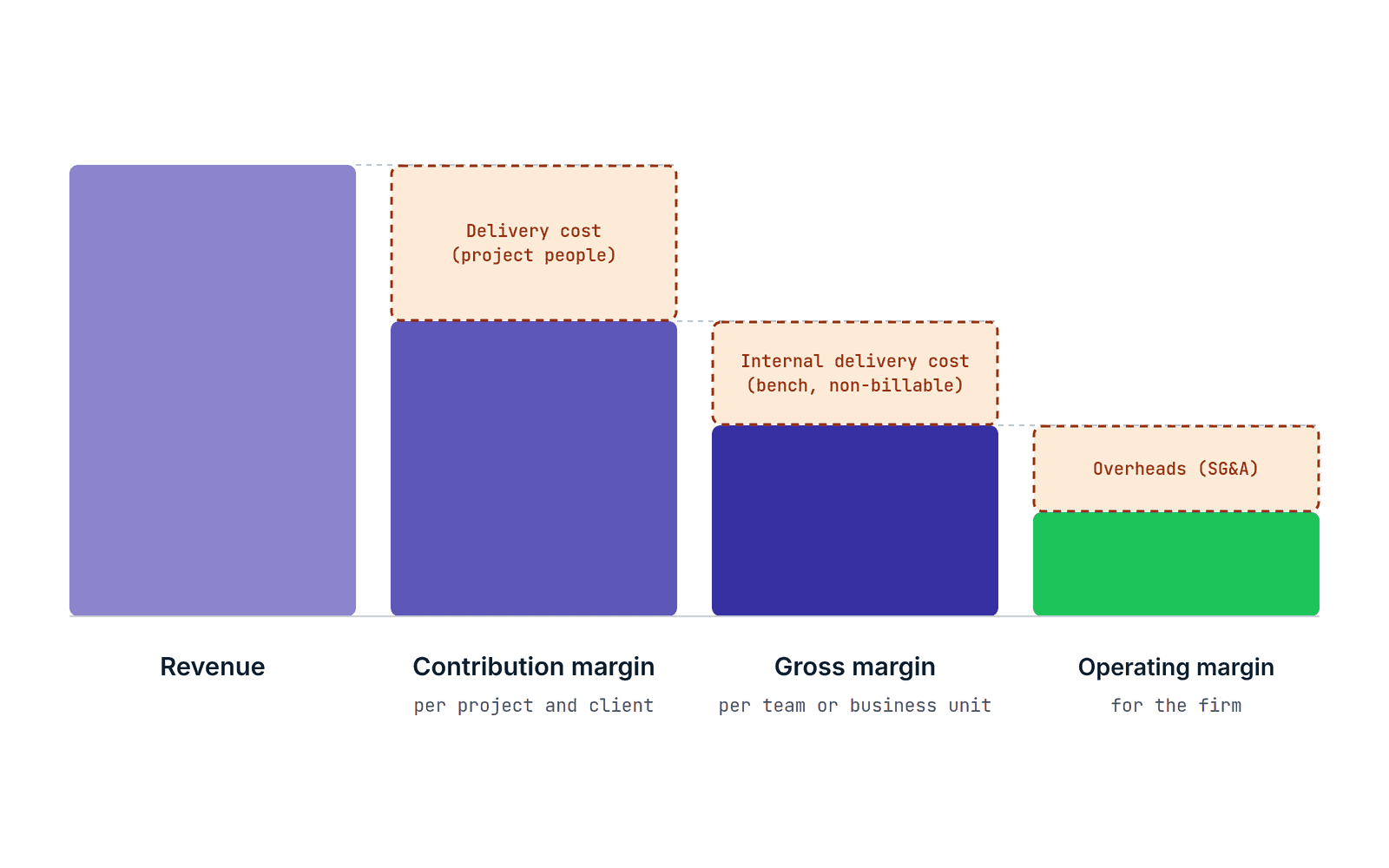
Count the cost the company carries.
Set each person’s annual cost, the month it applies from and the firm’s on-costs. Those dated inputs give the daily cost used in deal models, project plans and the P&L. A change applies from its month; past months keep their previous cost.
The forward company view separates delivery cost, Non-Billable Production Cost (bench, internal-project and leave-related cost) and SG&A, down to Operating Income. Overhead is planned as dated items by category and supplier. Check those lines against the way your firm currently explains its result.
Show what the next quarter depends on.
Read the outlook as Contracted, + Extensions and + Pipeline. The views are cumulative: signed work first, then extensions, then pipeline. A promising deal and a signed engagement do not become indistinguishable in one total.
Plans starts with the work, people and costs behind that outlook. Change the planning levers, review the gap to your target and the bookings needed to close it, then publish a Budget or Forecast. The model connects the inputs; management still owns the assumptions.
Give BU leaders figures they can explain.
Performance provides PL Detail, Clients and Business Units. Compare Actual with Budget, Last year or a forecast, with the value and percentage variance by line. Drill into the accounts, projects and people behind the selected view.
The board pack exports to branded Excel or PDF; PL Detail also exports to CSV. Finance can bring the result and the explanation to the meeting, while operating leaders update the work behind the next few months.
Close on the accounts. Learn from the difference.
Company actuals come from a monthly accounting CSV or the optional read-only Xero connection. The finance lead maps accounts to P&L lines and accepts each month. An accepted month shows company actuals in place of the outlook, and it can be hard-closed.
Accepted time supplies delivered project cost. It does not automatically rewrite forecast revenue. Keep those different sources and the reporting period clear when checking the company result.
Put one reporting period through the model.
Take one month and one decision: a delayed start, a staffing change or a revised rate. Trace delivery cost, unused capacity and SG&A to Operating Income. Compare the BU and firm views, then inspect the board output.
A useful evaluation produces an explanation you can check against your own method, including any missing inputs. That is more valuable than another dashboard labelled “profitability”.
Follow the question that matters next.
For advisers who want client meetings to focus on decisions rather than assembling the next forecast. Accountants and fractional CFOs
For firms keeping Xero, MYOB or QuickBooks while improving delivery planning and company forecasting. Project planning alongside your accounting system
See all starting pointsWhich part of your company forecast takes the most work to explain?
Request early access to examine the workflow against your firm’s reporting and planning needs.