Insights
Revenue is growing. Why is profit not following?
Revenue growth does not automatically become profit growth in a services firm. Profit follows the quality of the revenue, the pricing discipline behind it, the leverage model used to deliver it, and how quickly leaders see the financial consequences of operating decisions.
Revenue growth is easy to celebrate.
The firm is bigger, the team is busier and the pipeline looks healthier. The client list has improved, and the leadership meeting starts with a better top-line number than last year.
Then the P&L arrives.
Operating margin has not moved the way revenue has. Gross margin is softer than expected. Utilisation is high in some teams and patchy in others. Senior people are busier than ever. Project managers say delivery is under control, but finance sees margin erosion after the fact. Sales has won more work, but the business does not feel easier to run.
This is a common trap in IT services and professional services firms: assuming that revenue growth will naturally become profit growth.
It usually does not.
In a services firm, profit does not follow revenue automatically. Profit follows the quality of the revenue, the pricing discipline behind it, the leverage model used to deliver it, the amount of complexity created by it, and the speed at which leaders see the financial consequences of operating decisions.
A firm can grow revenue and become less profitable at the same time. Growth exposes weaknesses in the business model that were easier to hide when the firm was smaller.
The question for owners goes beyond "How do we sell more?" A better one is this.
Are we growing the kind of work, at the right margin, with the right delivery model, in a way the firm can actually scale?
1. Not all revenue deserves celebration
The first problem is the revenue myth: the belief that all revenue is good revenue.
In smaller firms, this belief is understandable. Every new client matters. Every new project helps fund the team. Every large deal feels like proof that the market values the business.
But as the firm grows, the quality of revenue starts to matter more than the quantity of revenue.
Some revenue is structurally attractive. It fits the firm's capability, uses the right people, carries the right price, has manageable delivery risk, and creates repeatable margin.
Other revenue looks attractive on the surface but consumes the firm underneath. It requires custom reporting, special governance, senior escalation, unusual billing terms, constant scope negotiation, or delivery patterns that do not match the way the firm is designed to work.
This is where owners can get caught.
A large client may produce impressive top-line revenue while quietly absorbing the best senior people, creating delivery exceptions, demanding discounts, and pulling management attention away from more profitable work. A smaller client may produce less revenue but be cleaner to serve, easier to renew, and stronger in contribution margin.
Revenue and profit do not always sit in the same place.
That is the profit pool problem. The areas where the firm earns the most revenue are not always the areas where it earns the best profit. If leadership only looks at revenue by client, service line, or practice, the firm can accidentally starve its real profit engine while feeding the parts of the business that create noise.
An owner should be able to answer:
- Which clients create the most contribution margin?
- Which services consume disproportionate senior capacity?
- Which deals look good in the CRM but weak in delivery?
- Which revenue streams would we not replace if they disappeared?
Until those questions are visible, growth can easily mean more work without more profit.
2. Growth funds capacity before it funds profit
The second problem is the leverage illusion.
Many services firms grow by hiring more people in roughly the same shape as the current team. If the firm has a senior-heavy delivery model at 30 people, it often recreates a senior-heavy delivery model at 50 people.
The result is a bigger business, but not a structurally more profitable one.
AI changes the arithmetic of that mix without changing the conclusion, as set out in AI will make services firms more productive. Not automatically more profitable..
The firm has more revenue and more people, but the ratio between senior cost, junior leverage, delivery management, and client work has not changed. The business has funded capacity, not profit.
This matters because professional services economics depend heavily on leverage. A high-end advisory firm, a project delivery firm, and a managed services firm should not have the same pyramid, utilisation assumptions, pricing model, or margin target.
A premium consulting model may tolerate lower utilisation if rates and senior leverage are strong enough. A managed services model needs repeatability and low variance. A project delivery model needs strong control over phase economics, role mix, and scope changes. A growth-stage hybrid firm needs to know which model is actually driving profit and which model is consuming it.
When these models are blended together, leadership often sees one gross margin for the whole firm. The blend hides the truth.
One team may earn a 40% gross margin through repeatable managed services, with its people fully utilised. Another may earn 15%, because its custom project work keeps needing senior rescue and its people sit on the bench between projects. Blended together, the P&L may look acceptable, but the operating reality is not.
That is why revenue growth often disappoints. The firm has grown, but the economic shape has not improved.
A useful test is:
Did growth change the economics of the firm, or did it only make the current model larger?
If growth simply adds more people, more exceptions, more client demands, and more management coordination, the operating margin may stay flat or fall.
3. Project margin is not company margin
The third problem is the project-margin illusion. A project can look healthy while the firm earns less. The project view and the company view measure different things, and they can tell opposite stories.
A services P&L has three levels of margin, each deducting more cost than the one before.
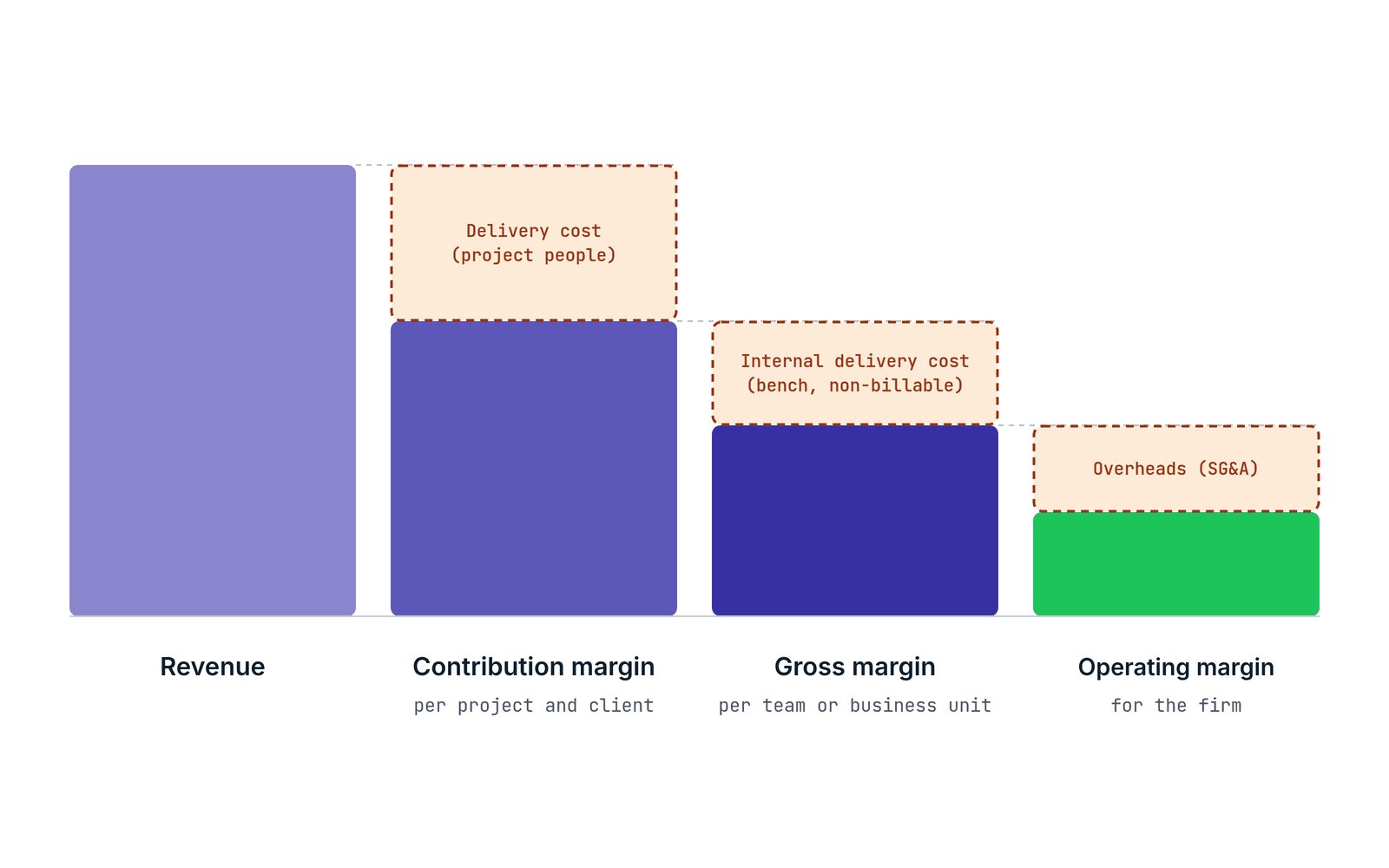
- Contribution margin, measured per project and client: revenue less delivery cost, the people working on the project.
- Gross margin, measured per team or business unit, and for delivery as a whole: also deducts internal delivery cost, the team's bench and non-billable time.
- Operating margin, measured for the firm: also deducts overheads (SG&A).
Project margin is contribution margin. Team or business-unit margin is gross margin, because a team carries its own bench and non-billable time. Operating margin is what the firm keeps.
An illustrative example: a project worth 100K runs for three months, and the firm looks at the result over six months. The same project can be staffed three ways.
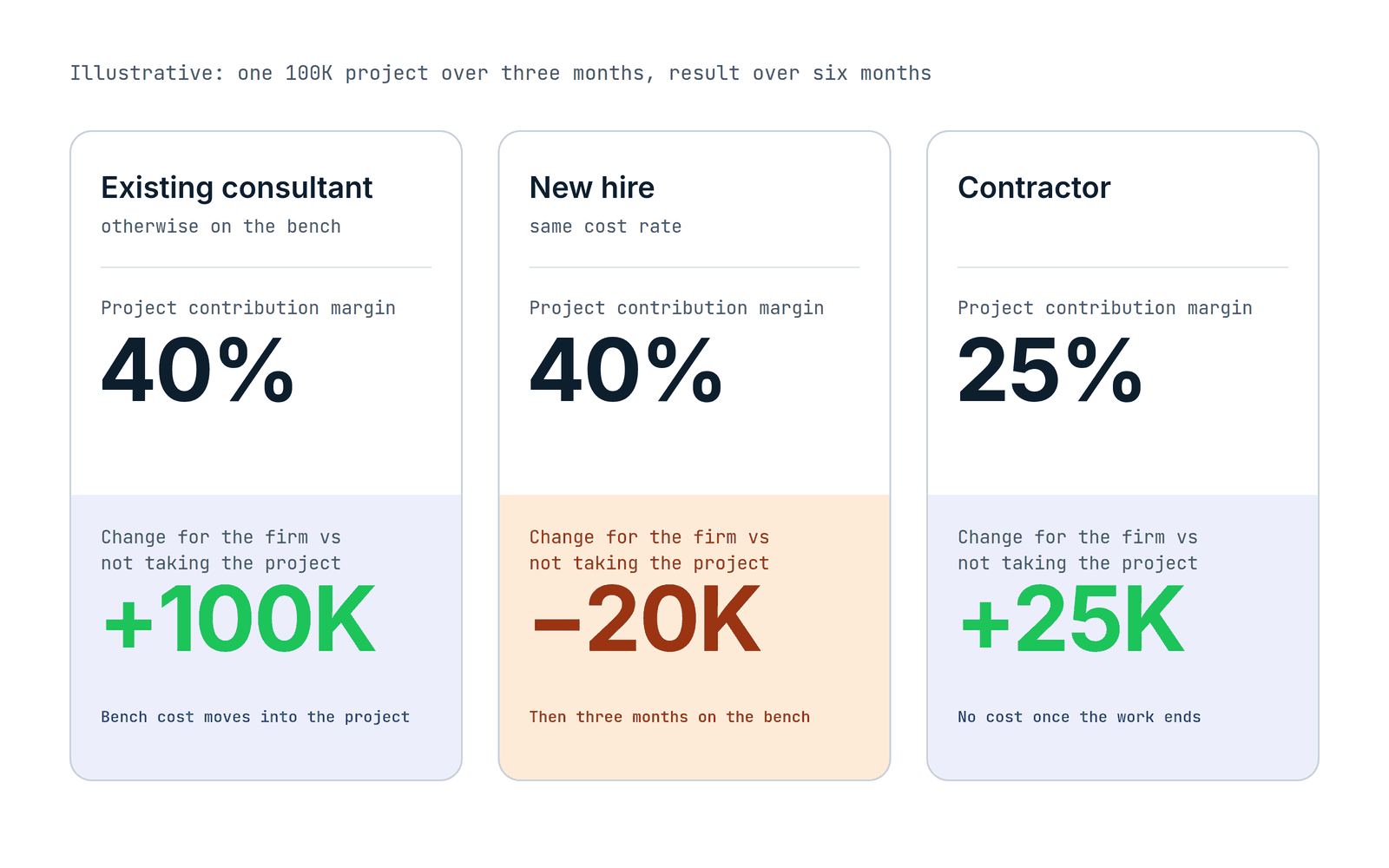
- An existing consultant who would otherwise be on the bench (60K cost): project contribution margin 40%. Change in company result over six months, compared with not taking the project: +100K. That is 40K contribution, and the 60K the consultant would have cost on the bench now sits in the project, so gross and operating margin rise by the full fee.
- A new hire at the same cost rate (60K): project contribution margin 40%. Change in company result: +40K during the project, then three months on the bench if no follow-on work arrives: −20K over six months.
- A contractor (75K): project contribution margin 25%. Change in company result: +25K, and no cost once the work ends.
Both employees return to the bench after month three; only the new hire's cost is new. The first two look identical on the project and are very different for the firm. The contractor looks weakest on the project, yet beats the new hire for short work.
The balancing act is to keep your own people utilised, hire where capacity matches lasting demand, and use contractors for peaks, non-core skills or uncertain work.
To manage profit you need both views. Most firms see the project margin clearly, but the team's bench and the firm's overheads sit elsewhere in the books, so the team and company result shows up later.
Judge a staffing decision on the company result, not only on the project margin.
4. Pricing mistakes are amplified in services firms
The fourth problem is pricing discipline.
In services firms, discounting hits profit quickly because the delivery cost often remains. A 5% or 10% discount does not reduce the work required by 5% or 10%. The same people still need to deliver the work. The same meetings happen. The same project management is required. The same senior oversight may be needed.
The discount comes straight out of margin.
This is why pricing has asymmetric power. Small improvements in price can create large improvements in operating profit. The reverse is also true: casual discounting can destroy profit far faster than sales teams expect.
The issue is not only the formal discount on the proposal.
Margin leaks through many smaller commercial decisions:
- A relationship discount to win the deal
- A fixed price estimate that assumes the best case
- A scope change absorbed to keep the client happy
- Senior people substituted without changing the economics
- Delivery work done but not billed
- CPI or rate review clauses left out of the contract
- A project extension treated as goodwill instead of commercial scope
Each decision can feel reasonable in isolation. Together, they create a pocket-price waterfall: the gap between the price the firm thought it sold and the economic value it actually captured.
This is especially dangerous in IT services, where client relationships matter and delivery teams often want to be helpful. No one wants to damage trust by charging for every small request. But there is a difference between commercial judgement and invisible leakage.
Flexibility is fine. The trouble starts when nobody can see what it cost.
A firm can choose to discount. It can choose to absorb scope. It can choose to invest in a strategic client. But those choices should be explicit. Leadership should know what margin has been traded, why, and whether the client or opportunity is worth it.
The operating principle is simple:
Sell at target margin first. Adjust only when the commercial reason is visible.
Without that discipline, revenue growth becomes a way to buy work rather than build profit.
5. Complexity quietly consumes the margin
The fifth problem is complexity.
Growth adds complexity naturally: more clients, service lines, delivery models, locations, roles and grades, and with them more exceptions, systems and internal coordination.
Some complexity is valuable. A broader capability set can make the firm more attractive to enterprise clients. A new service line can open a better profit pool. A more mature management structure can help the firm scale.
But unmanaged complexity is expensive.
It creates invisible overhead. It increases the amount of internal work required to deliver external work. It makes staffing harder. It creates more handoffs, more meetings, more reporting, more interpretation, and more exceptions to manage.
The danger is that complexity often arrives disguised as growth.
A client asks for a special delivery model. A practice creates a custom spreadsheet. A project requires a one-off pricing structure. A senior person keeps a side model to track "the real numbers." Finance maintains a separate view because the operational data is not trusted. Sales has a version of margin. Delivery has another. Finance reconstructs the story later.
At some point, the firm is not running one business. It is running several loosely connected versions of the business.
This is where margin disappears. It rarely goes in one dramatic mistake. It goes in the friction between disconnected views.
The antidote is not to eliminate all complexity. Professional services firms need judgement, flexibility, and client-specific nuance. The antidote is to make complexity visible and intentional.
Owners need to know:
- Which service lines carry which margin logic?
- Which clients create exception handling?
- Which roles are being used where?
- Which delivery models scale, and which require constant senior intervention?
- Which parts of the business are growing revenue but adding overhead faster?
If the firm cannot see those answers clearly, complexity will keep eating the profit that growth was supposed to create.
6. Delivery can look green while margin turns red
The sixth problem is the green status illusion.
A project can look fine operationally while failing financially. The client is happy, the milestone is met and the weekly status report is green. But underneath, the economics have changed.
A senior architect stepped in to do mid-level work because it was faster. A junior person was replaced by a contractor. A few "small" requests were absorbed. The timeline moved. A phase took longer than estimated. The team logged time late or smoothed the timecard to match the plan. The delivery lead protected the client relationship, but the margin case quietly broke.
Finance sees it later, when the work is done and the chance to recover scope has passed. Operational status and financial truth need to be connected earlier.
Every project has two contribution margins: the one it was sold at, and the one it is delivering. Most firms know the first from the deal spreadsheet and lose sight of the second.
Project managers should know whether the project is still delivering against the commercial case it was sold on, not only whether the client is satisfied. If a senior person is substituted, the project margin should move. If actual hours exceed the plan, the margin should move. If scope is added, the forward view should move.
The principle is:
Delivery reality should create financial insight at the point it happens, not after finance reconstructs it.
7. The P&L is necessary, but too late for steering
The monthly P&L matters. It is the financial record of the business, and it provides discipline, accountability, and closed-book accuracy.
But it is not enough to run a growing services firm. By the time it confirms a margin problem, the deal, the scope, the bench cost and the discount are weeks or months old. The P&L explains the result. It does not prevent it.
Moving that signal earlier is a design decision, worked through in Profitability principles are known. The hard part is running them..
Owners need forward signals that carry financial meaning, such as:
- The deal model before the work is won
- The role mix before the commitment is made
- The project margin as delivery changes
- The scope extension before it is signed or lost
- The bench cost before it becomes a month-end surprise
- The pipeline impact before it is blended into one optimistic forecast
Many firms reach for more spreadsheets: pricing, utilisation, project margin, forecast, resourcing. Each may be useful locally, but together they create multiple versions of truth. What helps is moving the financial signal earlier, to where the decision is made.
The people closest to the decision create the financial signal through the normal workflow. Sales models the deal, delivery updates the project, consultants record actual time and people leaders manage capacity. Finance sees the consequence without translating disconnected files later.
That is the difference between reporting and operating control.
8. The real fix: embed profit principles where the work happens
The firms that improve profitability do not rely only on dashboards. They install operating principles.
Examples:
- Every qualified deal has a deal model.
- Deals are submitted at target contribution margin before discounting.
- CPI or rate review discipline is built into contract thinking.
- Actual hours are recorded as worked.
- Scope changes are treated as commercial events.
- Staffing conflicts have clear decision rights.
- Open roles and bench are reviewed as financial exposure.
- Contracted work, likely extensions, and modelled pipeline are viewed separately.
These principles are not complicated. Most experienced services leaders recognise them immediately.
The hard part is running them consistently as the firm grows.
If the principles live in policy documents, leadership meetings, or spreadsheets, they eventually drift. People are busy. Exceptions multiply. Client pressure rises. Sales wants the deal. Delivery wants the relationship. Finance sees the consequence late.
The principle only holds when it lives inside the workflow.
Profitdrive is designed around these principles. It shows contribution, gross and operating margin for the months ahead and for actuals, so leaders see the project view and the company view before they decide. It shows the firm's P&L for the months ahead as contracted work, then with extensions, then with pipeline, so owners can see what is contracted, what could expand, and what future work would add if it converts. You set the plan on that base and see the gap to reach it. Your accounting actuals, from Xero or a monthly import, and accepted timecards show what actually happened, by project and client, next to the outlook.
Revenue growth does not become profit growth by accident. It becomes profit growth when the firm chooses the right work, prices it properly, delivers it with the right leverage, controls complexity, and sees margin movement early enough to act.
For owners, the final question is simple:
Is your firm learning about profit while there is still time to change the outcome, or only after the month has already closed?
Related: how an IT or professional services firm can see its forward P&L and how a priced deal becomes your delivery plan and your P&L.
Where this shows up in Profitdrive.
If you want to see where your own firm's profit is heading, you can request access to Profitdrive.
More insights
The Connected Services Firm
A practical operating model for IT and professional services firms that connects the decisions behind deals, people, delivery, profit and cash, and gives people and AI one governed record to work from.
Read articleAI will make services firms more productive. Not automatically more profitable.
AI is speeding up services delivery, but speed and profit are not the same thing. Without pricing discipline and a redesigned operating model, productivity gains become client discounts rather than margin.
Read articleProfitability principles are known. The hard part is running them.
Most services firm owners already know the profitability principles. The hard part is running them once the firm grows past what the founder can see day to day.
Read article